Reading the chapters, one decision at a time
- Separate the channels before counting anything. Known: we gave material, bid work, labor and consulting, and counted it as one line. The question was whether those behaved the same way once they arrived at a chapter, because if they did not, one blended number was hiding the answer. It produced the split in the table below, and it changed the unit of the relationship from dollars given to channels open.
- Treat a decline as information, not as an ending. Known: a chapter had passed on material it would once have taken. The question was whether that was a bad month or a ceiling. I set the bar at a second decline inside the same season, because a single pass can be a full truck or a bad week, and a pattern cannot. It produced a trigger a foreman or an estimator could act on without calling me.
- Ask the chapter what it could use before offering what we could spare. Known: our surplus was set by our jobs, not by their builds. The question, put to each chapter directly, was what the coming season actually needed from a contractor. It changed the offer. Where the yard was full, the offer became an estimator's time on a bid, a crew on a build day, or an opinion on a detail.
- Keep the channel decision per chapter. Known: different chapters, different yards. The question was whether a rule that fit Santa Barbara fit Los Angeles, and it did not have to. Material still went where a chapter could use it. The flows went where it could not.
- Price the flows honestly inside the firm. Known: surplus material off a job costs a contractor almost nothing to hand over. A crew day or an estimator's afternoon is payroll pulled off billable work. The question was whether we were willing to keep the relationship at that price. I was, and I owned that call as the person running the firm, because it is a real budget decision even when it is never written as one.
| Material | Bid work, labor, consulting | |
|---|---|---|
| What it is | A stock. Surplus product off active jobs | A flow. An estimator's time, a crew's day, a construction opinion |
| Where it sits after delivery | In the chapter's yard, until it is sorted and matched to a plan | Nowhere. It is consumed the day it is delivered |
| What limits it | The chapter's storage, its sorting labor and its plan set | The chapter's ability to supervise and schedule the work |
| What saturation looks like | Offers declined or limited | Not reached in this relationship |
| The trigger | A second decline inside one season | The same test, applied to scheduling rather than storage |
| The move | Stop offering material to that chapter | Offer a flow instead, and do not shrink the commitment |
What the chapters got, and what came back
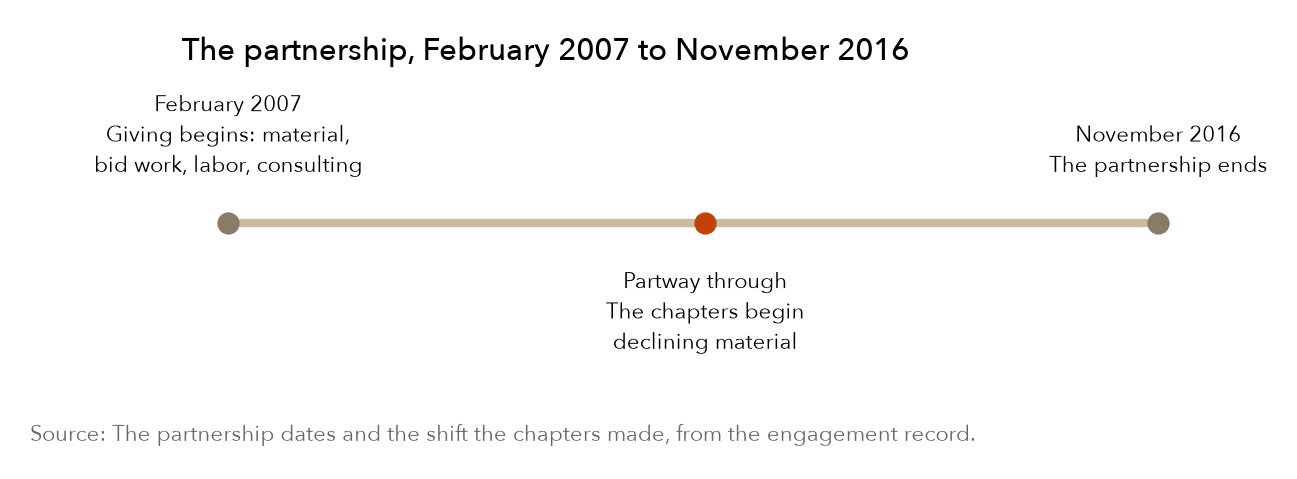
What this produced is the relationship itself and its length. Material reached chapters in three counties for as long as they could use it, and after that the same chapters got bid work, crews and consulting from a firm they already knew. There is no dollar figure on the material and I have never put one on it, because nobody itemized surplus product off a job site in those years and I will not invent a total after the fact.
What came back to Tellus was standing. A firm that keeps showing up, bid after bid and season after season, becomes a partner a chapter can plan around, and the people who run those chapters remember who came when there was nothing in it for them. It cannot be assembled after the fact; the only way to have it is to have spent the years.
What we kept, and the question we replaced
We kept the relationship, and we kept giving the crews' time to it after the free channel closed. We replaced one question with another. The old question, how much the firm could afford to give this year, was mine. I put it in because that is how a contractor thinks about anything that leaves the yard. The fault in it is that it measures the wrong side. The donor's willingness never stopped being the answer to it, so it could never have told us anything had changed. It had to change when it did because the chapters had answered a question we were not asking, and delivering material into a full yard would have cost them sorting labor and storage to spare us a decision.
The surplus-capacity rule
- Name each thing you give as a stock or a flow before you count any of it.
- Ask the recipient what the coming season needs before offering what you have spare.
- A second decline of a channel inside one season closes that channel with that recipient.
- Switch to a flow. Do not shrink the commitment, and price the flow honestly inside the firm.
- Track the open channel per recipient. One chapter's ceiling is not another's.
Attachment A carries the procedure in full.
What it cost, and what I would watch
The cost was real and it was ours. Surplus material had made the relationship close to free. Once the flows were the gift, the price was crew days off billable work and an estimator's hours on bids that paid nothing. The rule also removes the easy exit. Once you know a stalled channel does not mean a finished relationship, "they stopped taking what we give" stops working as a reason to stop, and the only honest way out is to decide, out loud, that the flows are not worth their price.
What I would watch, on any partnership that runs on more than one kind of contribution:
- The second decline. One is a bad week. Two is the recipient telling you where their ceiling is; the first one is noise.
- Which side the constraint sits on. If your budget still says yes and they are saying no, the limit is theirs, and the fix is a different channel, not a smaller one.
- The flows' own ceiling. Labor and consulting do not need a yard, but they need someone on the recipient's side to schedule and supervise them. That limit is higher, not absent.
- Whether they still treat you as a partner. The proof the relationship is working is a recipient that can decline you and still calls you first.
What it produced
The relationship held from February 2007 to November 2016 across chapters in Santa Barbara, Orange County and Los Angeles. There is no dollar figure on the material; nobody itemized surplus product off a job site in those years, and none is invented after the fact. The rule the shift produced, treat material as a stock and bid work, labor and consulting as flows, is the reusable part.
A slice of the project list
A few related projects.
- Greensburg, Kansas: a green disaster rebuild funded by category-exclusive sponsors (2007 to 2008)
- Soft-story retrofits: a financed seismic compliance service line at Tellus (2017)
- Santa Monica House: a custom home finished through a 2020 crew shortage (2020)